

Why Build Custom Instead of Buying Complete?
Complete BMX bikes are a solid entry point. They are well-priced, pre-assembled, and ready to ride. But they are also compromises. The manufacturer picks parts that hit a price point, not parts optimized for a specific rider's height, style, or terrain preference.
A custom BMX build solves that. Street riders who prioritize barspins want a different bar width and stem setup than park riders focused on technical grinds. A tall adult rider on a 29-inch cruiser needs completely different geometry than a mid-sized rider running a 20-inch freestyle setup.
When riders go custom, every BMX bike part on the build earns its place. There is no dead weight, no parts swapped out two weeks after purchase. Billet BMX makes it easy to source individual components without buying a full bike just to get the one part that actually matters.
Start with BMX Frame Selection
The frame is the foundation of everything. Every other part flows from the geometry of the frame - the top tube length, the chainstay, the head tube angle, and the bottom bracket height all determine how the bike rides before a single pedal stroke.
For riders building around SE Bikes compatibility, custom SE Big Ripper parts need to match the specific dropout spacing and axle standards of that platform. The Big Ripper runs a 3/8-inch or 14mm rear axle depending on the build year, which affects what hubs, axle nuts, and chain tensioners are compatible.
Billet BMX carries parts designed to fit SE Bikes frames correctly, which saves riders the headache of buying components that look right but do not fit.
The Stem and Fork Combo
One of the most underrated decisions in a custom BMX build is the BMX stem and fork combo. Riders often focus heavily on the frame and then throw on whatever stem and fork are available, which creates handling inconsistencies that are hard to diagnose.
The fork's offset controls how the bike steers. A higher offset creates more relaxed, stable steering. A lower offset tightens it up for responsive, twitchy handling. Street and flatland riders often prefer a tighter setup. Cruiser and wheelie bike riders generally want something more stable.
The stem rise and reach then determine bar height and how far forward the bars sit relative to the rider. Running the wrong stem on the right frame is like wearing shoes one size off - everything feels slightly wrong and the fix is obvious once made.
Custom BMX Handlebars: More Than Aesthetics
Custom BMX handlebars are one of the most immediately noticeable upgrades on any build. Bar height, width, and upsweep all affect control and comfort significantly.
Taller bars work well for taller riders and those who prefer an upright position on wheelie bikes and cruisers. Lower, narrower bars suit riders who want tight barspin clearance and a more aggressive forward lean for street riding.
Material matters too. Chromoly steel bars handle impacts better than hi-tensile steel and carry less flex at the joints. For a build meant to last through real sessions, Cr-Mo is the standard choice.
Build Your Dream BMX with Billet BMX
From SE Bikes compatible parts to full custom builds - everything in one place. Chain tensioners, axle nuts, handlebars, cranks and more.
Building the Drivetrain: Cranks, Chain, and Gearing
The drivetrain is where power transfer happens. A custom BMX parts list that skips drivetrain attention usually shows up as sluggish feel, chain skip, or premature wear.
Standard BMX gearing runs a 25-9 setup - a 25-tooth sprocket with a 9-tooth driver. This works for most street and park riding. Riders who do a lot of grinding favor a smaller sprocket to reduce the chance of contact. Wheelie and cruiser builds sometimes run slightly different ratios for better low-speed torque.
Billet BMX stocks chain tensioners, cranks, chains, and axle hardware that fit both 3/8-inch and 14mm setups, making it one of the more practical destinations for sourcing a full custom drivetrain without cross-shopping across multiple vendors.
Custom BMX Parts at a Glance
What to look for in each part of a custom build
Wheels, Axle Nuts, and the Details That Matter
A custom build is only as good as its weakest component. Riders who spend carefully on a frame and cranks and then cut corners on axle nuts or rims end up replacing those parts inside six months.
Double-wall rims are the standard for any riding beyond casual cruising. They handle impacts without folding. Sealed bearing hubs protect against dirt and moisture and require less maintenance than open bearing setups.
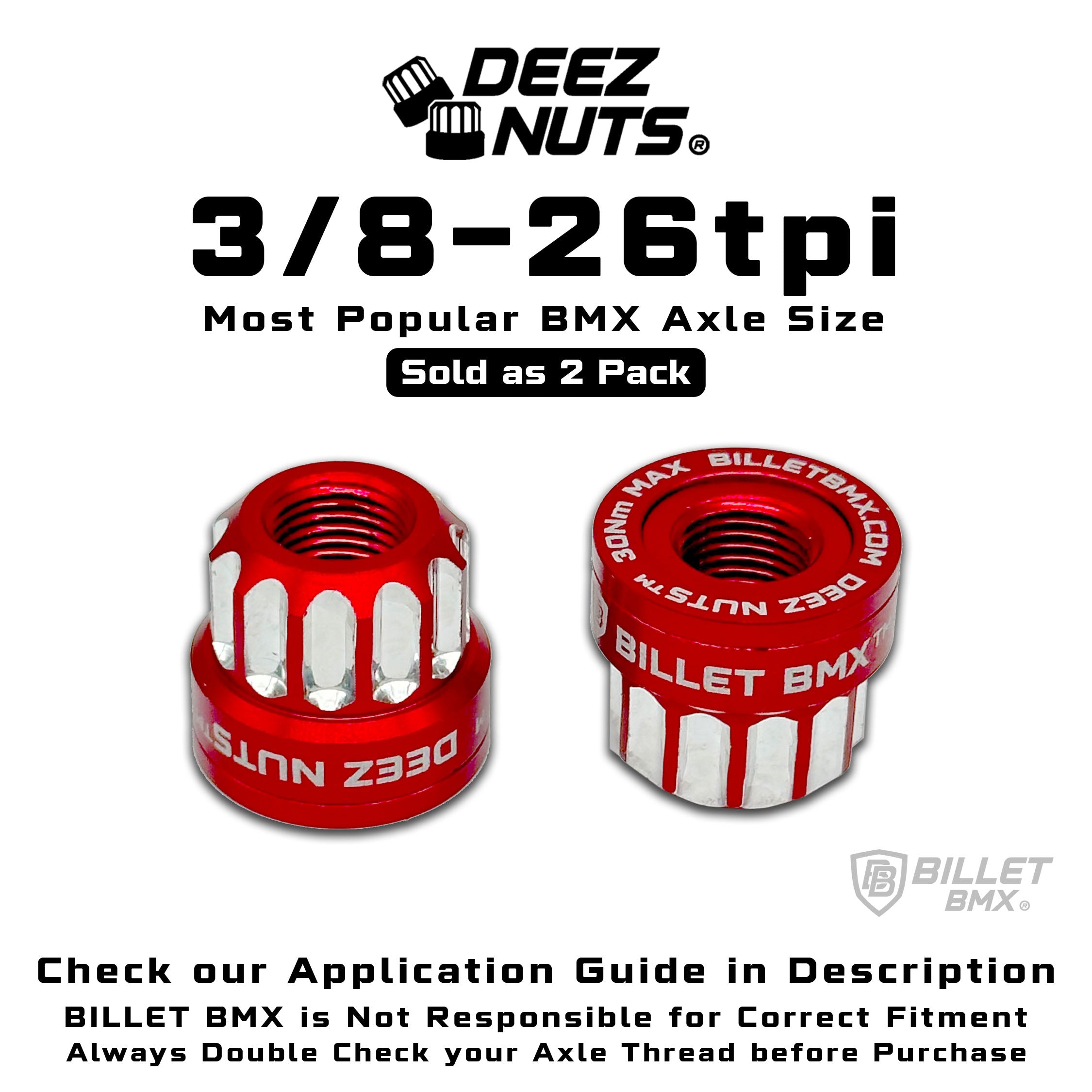
The 12-point axle nuts from Billet BMX are a popular detail upgrade - they hold under stress, strip far less easily than standard hex nuts, and come in a range of anodized colors that finish off a custom build cleanly.
How to Build BMX from Scratch: The Order of Operations
For riders wondering how to build BMX from scratch without wasting money on incompatible parts, the sequence matters. Start with the frame and fork. Then select the headset that fits the head tube. Build out the cockpit next - stem, bars, grips. Move to the drivetrain. Finish with wheels, pegs, and hardware.
Checking compatibility at each step prevents the frustration of a part that almost fits. Billet BMX organizes its inventory by category and compatibility, which makes cross-referencing straightforward even for first-time builders.
Shop Custom BMX Parts at Billet BMX
Everything needed for a complete custom build - in one place

Conclusion
A custom BMX build is an investment in exactly the ride a rider wants, not a compromise off a production line. Getting the BMX frame selection right, pairing a proper stem and fork combo, choosing custom BMX handlebars that match the riding style, and building a drivetrain that holds up - these decisions compound into a bike that performs every session.
Billet BMX stocks the custom BMX parts and BMX bike parts that serious builders actually need, with the range to cover SE Bikes compatibility, cruiser builds, freestyle setups, and everything in between. For riders ready to stop guessing and start building, it starts with finding the right parts from a source that knows the platform.
Frequently Asked Questions
Q1: What are the most important custom BMX parts to prioritize in a build?
Start with the frame, fork, and stem - these three components determine how the entire bike handles. Getting those right first makes every other part's decision easier and more precise.
Q2: Can Billet BMX parts fit SE Bikes frames like the Big Ripper?
Yes. Billet BMX carries components specifically compatible with SE Bikes frames, including chain tensioners, axle nuts, and handlebars that match the axle standards and geometry of the Big Ripper and other SE models.
Q3: How long does it take to build a custom BMX from scratch?
Most riders complete a custom BMX build in a few hours once all parts are sourced. First-time builders should budget extra time for compatibility checks and allow a day for parts to arrive if ordering online.
Q4: What is the best BMX gearing setup for street riding?
A 25-9 setup is the most common choice for street riding. It balances acceleration and top speed well. Riders who grind frequently often run a smaller front sprocket to reduce contact with rails and ledges.
Q5: Where can riders find a reliable BMX bike parts list for a custom build?
Billet BMX organizes parts by category and compatibility, making it straightforward to cross-reference components for any build. Starting with frame specs and working outward through the drivetrain and cockpit keeps the list manageable and accurate.


