
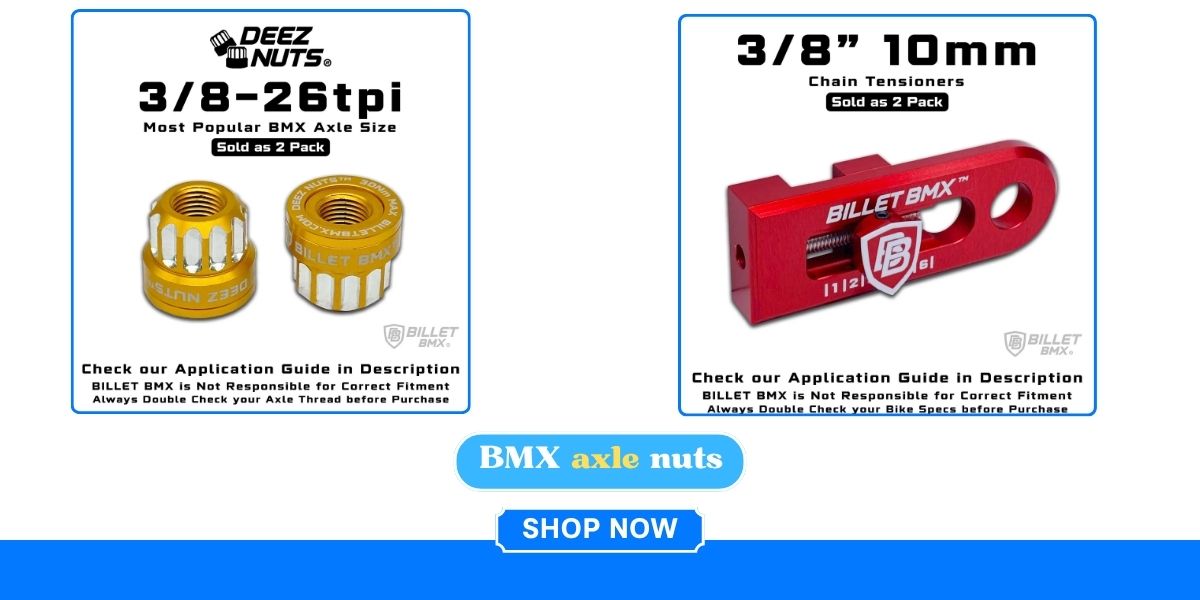
Most riders don't think about their bmx axle nuts until one strips out, rounds off, or goes missing after a wheel swap. Then it's suddenly the most urgent part on the bike. The truth is, these small threaded fasteners do a job that no amount of cool components can compensate for - they keep your wheels locked into the dropouts and your ride safe every session.
This guide breaks down the sizes, materials, and compatibility details you actually need to know before you order a replacement set.
Why Axle Nuts Matter More Than You Think
Here's a scenario most riders have lived through: you swap a wheel in the parking lot before a session, tighten things up by feel, and twenty minutes later your rear wheel has shifted in the dropout and your chain is skipping. Nine times out of ten, the culprit is under-torqued or mismatched bicycle axle nuts - not a frame problem, not a hub problem.
BMX bikes don't use quick-release systems. That means your axle nuts are the only thing holding your wheels in place against hard landings, rail grinds, and gate starts. They absorb constant stress, and when they're worn, wrong-sized, or improperly torqued, you feel it in your alignment, your chain tension, and eventually in damaged threads on the axle itself.
Getting the right set - and knowing how to torque them correctly - is genuinely one of the easiest ways to make your bike feel more dialed.
3/8 vs 14mm: Understanding the Two Main Sizes
This is the question that trips up most riders shopping for bike axle nuts online: which size do you actually need?
3/8" BMX Axle Nuts
The 3/8" axle (technically 3/8" x 26TPI thread) is the older standard, still widely used on front wheels and on race-specific builds where lower weight is a priority. If you're running a classic race setup, an older freestyle frame, or a lightweight park build, you're likely dealing with 3/8 bmx axle nuts front and rear.

These pair with a 15mm hex wrench. They're lighter, which matters for riders shaving grams off a race build, but they offer slightly less clamping strength under heavy impact than their larger counterparts.
14mm BMX Axle Nuts
The 14mm bmx axle nuts are the modern standard for rear hubs on street, park, and dirt bikes. The larger diameter gives you more clamping surface and better durability under the kind of stress that comes with big drops and hard landings. Most contemporary BMX frames and rear hubs are built around 14mm axles - 14mm x 1.0 thread pitch, paired with a 17mm hex wrench.
If your bike was built in the last ten years and you're a street or park rider, chances are your rear axle runs 14mm. Front axles on those same bikes often stay at 3/8". Check both ends before you order.
Materials: Steel, Aluminum, and Titanium
The material of your axle nuts affects weight, durability, and how they hold up to repeated tightening and loosening. Here's what to know:
Steel is the most common choice. It handles high stress well, resists rounding under a wrench, and holds thread integrity through repeated reinstalls. It's heavier than aluminum, but for street riders grinding pegs and making frequent wheel adjustments, steel is the reliable default.
Aluminum is lighter and runs in colors - which is partly why riders choose it. Quality aluminum nuts, like those made from 7075-T6, are genuinely strong enough for most riding. Just be aware that aluminum strips more easily if cross-threaded or overtightened, so proper installation matters more here.
Titanium is the premium option. It's as strong as steel at roughly half the weight, corrosion-resistant, and built to last. If you're building a weight-conscious race setup or just want hardware that outlasts everything else on the bike, titanium is worth the extra cost.
Billet BMX stocks axle nuts across all three materials, with clear spec callouts so you're not guessing about compatibility before you add to cart.
How Axle Nuts and Chain Tensioners Work Together
If you've ever had your rear wheel creep forward in the dropout mid-session, you already understand why bmx chain tensioners exist. Tensioners sit in the dropout and use an adjustable bolt to hold the axle in position while you set your chain tension - then the axle nuts lock everything in place.
The process is straightforward: loosen the axle nuts, thread in your tensioners, pull the wheel back until chain slack is around ¼ inch of play, align the wheel between the chainstays, and then torque the axle nuts down firmly. Always tighten the drive-side nut first, then the non-drive side, to keep the wheel centered.
Billet BMX makes chain tensioners from 6061 T6 aluminum with numbered markings on each side - so you can match the position exactly on both dropouts without eyeballing it. They're designed for 20mm to 3/8" axle setups and fit clean without external bolts that snag on grinds. You can read the full breakdown in the Billet BMX chain tensioner installation guide.
Quick Tips Before You Order
Confirm axle diameter first - 3/8" front, 14mm rear on most modern bikes, but not always
Match thread pitch - 3/8" x 26TPI or 14mm x 1.0 are standard; other pitches exist on older hubs
Buy in pairs - axle nuts wear together; replace both sides at the same time
Don't overtighten aluminum - use a torque wrench if you're unsure; stripped threads on the axle are a costly mistake
Inspect regularly - check for rounding on the hex faces and any thread damage after hard sessions
Conclusion
Your axle nuts are small, but they're holding everything together - literally. Whether you're running 3/8 bmx axle nuts on a race build or 14mm hardware on a street setup, getting the right size and material makes every session safer and more consistent. Browse the Billet BMX catalog, confirm your specs, and ride with hardware you can actually trust.
FAQs:-
Q: What size axle nuts do most BMX bikes use?
Most modern BMX bikes use 3/8" nuts on the front axle and 14mm nuts on the rear. Always confirm your axle diameter before ordering replacement bicycle axle nuts.
Q: What's the difference between 3/8 and 14mm BMX axle nuts?
The 3/8" is lighter and common on front or race hubs, while 14mm bmx axle nuts are larger, stronger, and standard on modern rear hubs for street and park riding.
Q: Do I need chain tensioners with my axle nuts?
Not required, but highly recommended. BMX chain tensioners help lock your rear wheel position so axle nuts stay properly torqued and chain tension stays consistent session to session.
Q: How tight should BMX axle nuts be torqued?
Firm and snug - typically 20–30 Nm for steel nuts. Avoid overtightening aluminum bike axle nuts as stripped axle threads are difficult and expensive to repair.
Q: Are Deez Nuts axle nuts compatible with standard BMX axles?
Deez Nuts axle nuts are typically made for standard 3/8" and 14mm axle sizes. Confirm thread pitch matches your hub spec before installing any specialty or aftermarket nut.


