
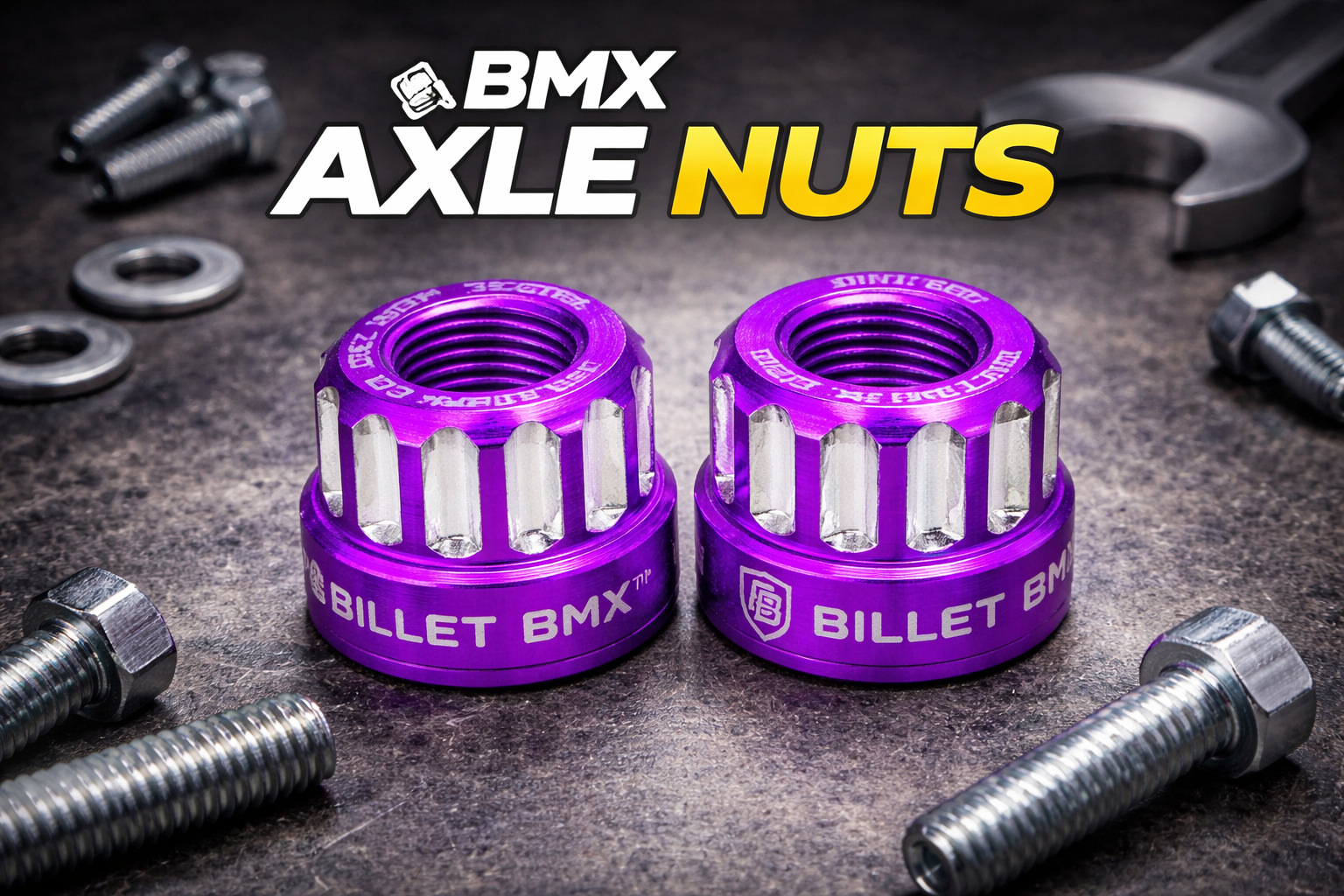
Most riders spend serious time picking frames, wheels, and cranks. Then they grab whatever axle nuts came with the bike and never think about it again. That works fine - until it doesn't. A stripped nut, a wrong size, or a loose axle mid-session is the kind of small problem that turns a good day into a frustrating one fast.
Getting your BMX axle sizes right is not complicated. But it does matter. And once you understand the basics, buying the right BMX axle nuts the first time becomes straightforward.
Why BMX Axle Sizes Matter More Than Most Riders Think
The axle nut is the last thing holding your wheel to your bike. It threads directly onto the axle, and if the thread pitch or diameter does not match, the nut either will not go on at all - or worse, it will go on but not hold properly.
BMX bikes use two main axle sizes. The 3/8 inch axle is the standard for most freestyle BMX bikes. It is what the majority of street, park, and flatland riders are running. The 14mm axle is common on BMX race bikes and some heavier-duty freestyle setups. Before you buy any BMX axle nuts, check which size your hubs use. It takes thirty seconds and saves a wasted order.
3/8 BMX axle nuts are by far the most widely available. They fit the standard 3/8 inch axle thread and come in a range of materials, profiles, and finishes. Most aftermarket nut sets you find at a BMX shop or online will be 3/8 unless specifically labeled otherwise.
Axle Nut Materials and Why They Are Not All Equal
Steel axle nuts are the most common and the most durable. They handle torque well, resist stripping better than softer metals, and hold their thread through rough use. For riders who grind pegs or put real stress on their axle hardware, steel is the safe call.
Aluminum nuts are lighter but softer. They work fine for casual riding and look clean on a lightweight build. The trade-off is they strip more easily, especially if you overtighten them or have to remove and reinstall them frequently.
Chromoly steel sits at the top end. Harder than standard steel, slightly lighter, and built to last through serious use. If you are buying once and not wanting to think about it again, chromoly is worth the small price difference.
Chrome BMX Axle Nuts - Function and Finish
Chrome BMX axle nuts do two things. They protect the steel underneath from rust and surface wear, and they add a clean polished look that holds up better than raw or painted finishes over time.
For riders who care about the overall look of their build, chrome axle nuts are a natural match for chrome rims, chrome bars, or any build with a classic raw metal aesthetic. But the practical case is just as strong. Chrome finish resists corrosion better than bare steel, which matters if you ride in wet conditions or store your bike outside.
Billet BMX carries chrome axle nuts that fit standard 3/8 BMX axle sizes and are built to the thread tolerances that prevent stripping and backing off under load.
Blue BMX Axle Nuts - Color That Holds Up
Blue BMX axle nuts are one of the most popular color choices for riders building a themed setup. The anodized finish used on quality colored nuts bonds to the metal surface rather than sitting on top of it, which means it does not chip, flake, or fade the way spray-painted hardware does.

If you are building around a blue colorway - blue grips, blue pegs, blue stem bolts - blue axle nuts pull the detail work together without looking forced. And because anodized aluminum takes the color evenly across the whole surface, they look consistent from any angle.
Billet BMX blue BMX axle nuts are available in the standard 3/8 size and use the same thread spec as OEM hardware, so fitment is direct and installation is straightforward.
Picking the Right Nut Profile for Your Riding
Beyond size and finish, nut profile affects how the hardware sits against your dropouts. Acorn nuts have a rounded domed cap that covers the exposed axle thread and looks clean. Flat or open-end nuts are more traditional and give a lower-profile look. Neither is better across the board - it comes down to dropout clearance and personal preference.
One thing that does matter for any profile: always torque axle nuts properly. Hand-tight is not enough. An under-torqued axle nut backs off during riding, which creates play in the wheel and leads to accelerated hub wear. A good rule of thumb is to tighten until snug, then give it a firm quarter turn more with a wrench.
Billet BMX stocks axle nuts across multiple finishes including chrome, blue, and raw options - all cut to fit standard BMX axle sizes without modification. Browse the full range and pick what works for your build.
FAQs
Q1: What is the standard BMX axle size?
Most freestyle BMX bikes use a 3/8 inch axle. Race bikes often use 14mm. Always check your hub spec before buying axle nuts.
Q2: Are 3/8 BMX axle nuts universal?
They fit any hub with a standard 3/8 inch threaded axle. Most freestyle BMX bikes share this spec, making 3/8 nuts widely compatible across brands.
Q3: Do chrome BMX axle nuts rust?
Quality chrome-plated nuts resist rust well in normal conditions. Avoid prolonged water exposure and dry them off after wet rides to maintain the finish longer.
Q5: How tight should BMX axle nuts be?
Snug plus a firm quarter turn with a wrench. Under-tightened nuts back off during riding. Over-tightening can strip threads, especially on aluminum axle nuts.


