
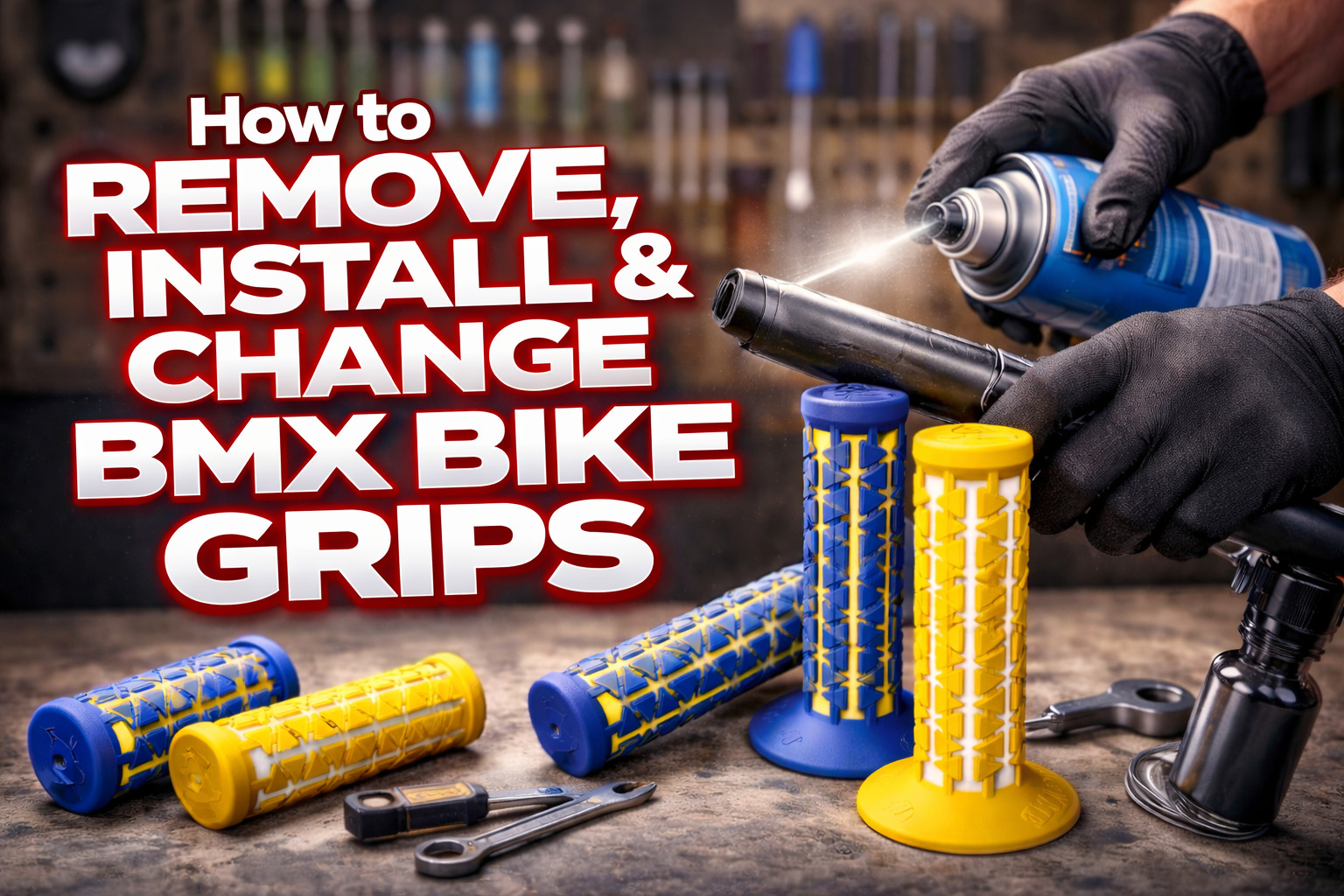
Your BMX bike grips are the one part of your bike you never stop touching. Every trick, every landing, every session - it all passes through your hands first. And yet, grips are the most overlooked upgrade in BMX. Riders will spend hundreds on a new frame but ride around on cracked, slippery grips for six months without a second thought.
Here's the truth: worn-out BMX grips kill your control, accelerate hand fatigue, and honestly just make the ride less fun. Whether you're replacing a beat-up pair, switching to lock-ons, or just want to know the right way to do this without wrecking your bars - this guide covers everything, start to finish.

How to Remove BMX Grips
Before you can install anything new, you've got to get the old grips off. This sounds simple until you're fifteen minutes in with rubber shreds on your floor and a scratched-up handlebar. Let's avoid that.
What you'll need: a flathead screwdriver, WD-40 or rubbing alcohol, and about five minutes.
Here's the method that works every time:
- Slide a thin flathead screwdriver gently under the edge of the grip - between the rubber and the bar. Go slow. You're creating a gap, not prying it off.
- Spray WD-40 or rubbing alcohol into that gap. Let it work its way around the grip for 30 seconds.
- Twist the grip back and forth while slowly pulling outward. It'll break loose faster than you'd expect.
- Repeat on the other side. Once both are off, wipe the bars clean. Any residue left behind will mess with your new grip's fitment.
If your old grips were glued on - which some riders do for extra hold - you may need to cut them off with a box cutter. That's fine. Grip glue grips are a one-way trip anyway.
Pro tip: An air compressor nozzle pushed under the grip edge is the fastest method of all. The compressed air inflates the grip away from the bar instantly. No screwdriver, no chemicals. If you have access to one, use it.
How to Install BMX Grips
Now for the part everyone gets wrong. Installing BMX grips the wrong way leads to grips that rotate mid-ride - which is dangerous, annoying, and completely avoidable.
Step-by-step for standard (slide-on) grips:
- Clean your bars thoroughly with rubbing alcohol. Remove every trace of old adhesive, dirt, and oil. Grips bond to clean bars. They slip on contaminated ones.
- Choose your lubricant. Hairspray is the classic - it goes on slippery, dries tacky, and bonds the grip lightly to the bar. Rubbing alcohol also works and evaporates clean. WD-40 gets the grip on easy but takes longer to set.
- Spray the inside of the grip and the end of the bar lightly.
- Push the grip on with a twisting motion. Don't force it straight - the twist distributes the lubricant and lets the grip slide without bunching.
- Align the grip immediately while the lubricant is still wet. This is your only window to adjust.
- Let it dry. Minimum 2 hours before riding. Overnight if you used grip glue.
Don't ride the bike straight after install. I've seen riders skip this step and wonder why their grips are spinning two days later.
How to Install New Lock-On BMX Grips Properly?
Lock-on BMX grips are a different game entirely - and once you've used them, it's hard to go back. They clamp onto the bar with a small Allen bolt, which means zero slipping, zero maintenance, and zero excuses.
Here's how to install them correctly:
- Loosen both clamp bolts with a 3mm or 4mm Allen key - don't remove them fully, just back them off enough to open the clamp.
- Slide the grip onto the bar. No lubricant needed. Lock-ons don't require it.
- Position the grip exactly where you want it. Check the angle if they're ergonomic or have a pattern direction.
- Tighten the inner clamp first (closest to the stem), then the outer clamp. Alternate between them in small increments - don't crank one fully before the other.
- Torque to about 3–4 Nm. Tight enough to hold under full riding force, not so tight you crack the clamp or strip the bolt.
Lock-ons are the professional standard for a reason. If you're riding regularly and sick of grip maintenance, this is the upgrade that makes sense.
How to Change BMX Grips
Changing BMX grips is just removing the old ones and installing the new ones - but timing matters as much as technique. Here's when you should change them:
- The rubber feels sticky, gummy, or is visibly cracking
- The grip spins or shifts during rides even after tightening
- The texture has worn smooth and your hands slip in wet conditions
- You've had them for more than 6 months of regular riding
Most active riders swap their grips every 3 to 6 months. It's one of the cheapest maintenance habits in BMX and one of the most impactful.
Grips for BMX - What to Look For in 2026
Not all BMX grips are built the same, and the difference between a $6 grip and a quality pair shows up on your first long session. Here's what actually matters:
Material: Rubber grips are the most durable. Softer compounds absorb vibration better. Dual-density grips give you both - firm inner layer for structure, soft outer layer for feel.
Flanged vs. Flangeless: Flanged grips have a raised edge that stops your hand from sliding off the end of the bar. Flangeless grips are preferred by street and freestyle riders who do barspins - no flange means nothing catching on your hands mid-spin.
Diameter and Length: Standard BMX bars are 22.2mm at the grip area. Most grips are universal here. Length is personal - longer grips for more hand coverage, shorter for a tighter feel.
Lock-On vs. Slide-On: Lock-ons are more expensive upfront but require zero maintenance and never spin. Slide-ons are cheaper and still work perfectly if installed correctly.
For a deeper breakdown of the best options available, check out the Best BMX Bike Grips for Comfort and Control guide on the Billet BMX blog - it covers soft vs. firm compounds, flanged vs. flangeless, and which styles work best by riding discipline.
Where to Buy Durable BMX Grips Online
You can find BMX grips everywhere online, but finding ones that actually last - and are built specifically for BMX riding - is a different question.
Billet BMX is where serious riders shop. Every grip in the Billet BMX lineup is engineered for BMX - not watered-down from MTB or cycling parts with a different label slapped on. The Diamond Series handlebar grips are a standout: UV-resistant rubber compound that won't go gummy in the sun, available in a full range of colors to match any build, and compatible with standard 22.2mm bars across the board.

What sets Billet BMX apart is the philosophy behind the parts. These aren't mass-produced commodity grips. They're designed by riders who know what happens when your grip spins at the wrong moment. The attention to material quality, texture depth, and compound density shows in how the grips hold up after months of hard use.
Whether you're looking for lock-on BMX grips, flanged options for park riding, or slim flangeless grips for street and barspins - this BMX shop has exactly what your build needs, built to last every session.
FAQs:-
Q: How do you remove BMX grips without cutting them?
Slide a flathead screwdriver under the grip edge to create a gap, spray WD-40 or rubbing alcohol inside, then twist and pull the grip off slowly. An air compressor works even faster without any tools or chemicals needed.
Q: What is the best way to install BMX grips so they don't spin?
Clean bars with rubbing alcohol first, then use hairspray as a lubricant inside the grip. Hairspray slides grips on easily and dries tacky, creating a light bond that prevents rotation during hard riding sessions.
Q: How often should you change BMX grips?
Most active BMX riders replace their grips every 3 to 6 months. Replace sooner if grips feel gummy, spin on the bar, or the texture has worn smooth and your hands slip during wet or sweaty sessions.
Q: Are lock-on BMX grips better than standard slide-on grips?
Lock-on BMX grips clamp firmly to the bar and never spin or shift, making them the preferred choice for regular riders. Slide-on grips are cheaper and work well if installed correctly with proper lubricant and drying time.
Q: Where can I buy durable BMX grips online in the USA?
Billet BMX offers premium BMX-specific grips built from UV-resistant rubber compounds. They stock flanged, flangeless, and lock-on styles in multiple colors, shipping fast across the USA and internationally.


