

A rider tightening down a wheel shouldn't have to guess whether the nuts on hand actually match the axle. It happens more than people expect - someone grabs a spare set of axle nuts, threads them halfway on, and realizes something's off. Axle nut size is one of those small details that gets overlooked until it causes a real problem at the dropout. Getting it right the first time saves a trip back to the shop and keeps the wheel seated where it should be.
What Are BMX Axle Nuts?
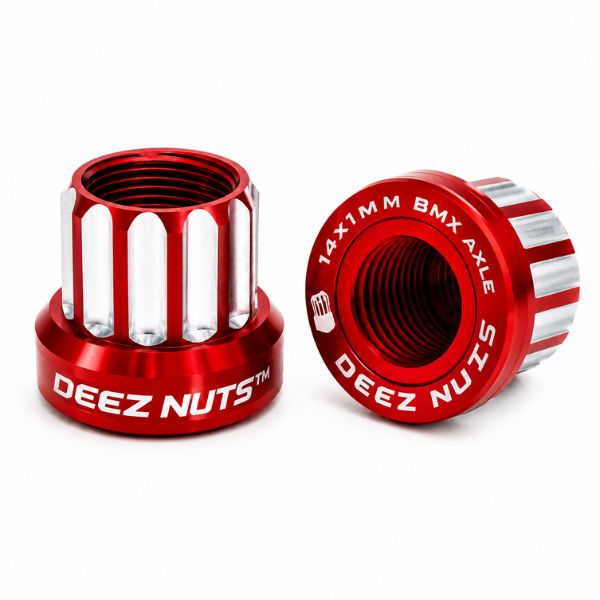
Axle nuts are the small threaded fasteners that clamp the wheel's axle into the fork or frame dropouts. Their job sounds simple, but it's a critical one - they keep the wheel centered, prevent it from shifting under hard pedaling or landings, and hold everything tight enough to handle the abuse BMX riding puts on a bike. Axle nut size matters because dropout width, hub design, and axle diameter all have to line up exactly. A mismatch means the nut either won't thread on at all or won't seat properly, which can lead to a wheel working loose mid-ride. In BMX, the two common axle standards riders run into are 3/8 inch and 14mm, and while they look similar at a glance, they are not the same thing.
Understanding 3/8 Inch BMX Axle Nuts
The 3/8 inch standard has been around BMX for decades and is still common on freestyle and street setups. Standard dimensions put the axle diameter at 3/8 inch, or roughly 9.5mm, which is slightly smaller than its metric counterpart. These nuts are compatible with hubs and forks built specifically around imperial sizing, which covers a large share of budget and mid-range BMX components.
On the plus side, 3/8 inch hardware is lightweight, widely available, and easy to source from almost any BMX shop, including Billet BMX. The downside is that it's generally considered less beefy under extreme stress compared to 14mm setups. Best use cases include street and park riding where the wheel isn't taking constant, repeated high-impact hits in the same way dirt jumping demands.
Understanding 14mm BMX Axle Nuts
The 14mm standard is the metric alternative and has become increasingly common on modern BMX bikes, especially those built for aggressive riding. Standard dimensions place the axle at a true 14mm diameter, giving it noticeably more material than the 3/8 inch version. These nuts pair with hubs and dropouts specifically machined for the metric standard, which is common on newer frames and higher-end hub sets.
The main advantage is added strength - that extra couple millimeters of diameter translates into a stiffer axle that resists bending under repeated impact. Best use cases lean toward dirt jump and race BMX, where landings and starts put serious stress on the rear wheel and a stronger axle reduces the risk of flex or failure.
3/8 vs 14mm BMX Axle Nuts
Laid side by side, the size comparison comes down to that roughly 4.5mm difference in axle diameter, which sounds small but has a real effect on strength and durability. The 14mm axle handles high-impact riding better simply because there's more metal resisting bend and torque. Weight differences favor 3/8 inch slightly, since less material means a few grams saved, though it's rarely enough to notice on the trail. Performance comparison generally favors 14mm for aggressive riding and 3/8 inch for lighter street or park use where the weight savings and easy part availability matter more. Compatibility is where things get strict - a hub built for one standard will not accept the other size, so riders need to know which their bike uses before ordering replacement hardware.
How to Identify Your BMX Axle Size
The most reliable method is to measure the axle diameter directly with calipers, since eyeballing 3/8 inch versus 14mm is nearly impossible without one. Checking manufacturer specifications is the next best option - most hub and frame brands list axle size in their product details or spec sheets. Inspecting the existing axle nuts can also help, since many are stamped with their size on the flat face. As for tools, a caliper gives the most accurate reading, but a properly fitting wrench also works as a quick check - a 3/8 inch nut typically takes a 9/16 inch wrench, while 14mm nuts pair with a 15mm wrench.
Which BMX Riders Should Choose 3/8 or 14mm?
Beginners often end up on whatever size came stock on their first bike, and either standard works fine while they're still building skills. Street riders frequently prefer 3/8 inch for its lighter weight and wide part availability. Park riders can go either way depending on how hard they ride transitions, though many stick with what their hub already uses. Dirt jump riders lean heavily toward 14mm because of the repeated hard landings that put real stress on the axle. Race BMX riders also favor 14mm, especially for the rear wheel, since gate starts and sprint power benefit from the added stiffness. Wheelie bike riders typically run 3/8 inch, since their riding style doesn't demand the extra strength that dirt or race setups need.
Are 3/8 and 14mm BMX Axle Nuts Interchangeable?
They are not interchangeable, and this trips up more riders than it should. The two standards have different thread diameters, so a 14mm nut simply will not thread onto a 3/8 inch axle, and vice versa - the threads won't catch correctly even if someone tries to force it. The risks of using the wrong size range from stripped threads to a nut that looks seated but isn't actually secure, which is a real safety concern. A loose or improperly threaded axle nut can let the wheel shift during riding, leading to sudden and dangerous wheel movement. Always match axle nuts to the exact hub standard rather than assuming close enough will work.
Choosing the Right BMX Axle Nut Material
Chromoly steel is a common choice thanks to its strength-to-weight ratio and resistance to bending under stress, making it a solid pick for riders who push their bikes hard. CNC-machined aluminum offers a lighter option and often comes in anodized colors for riders who want to match their build, though it typically wears faster under heavy impact. Heat-treated steel adds extra durability on top of standard steel, holding up well to repeated stress without deforming. Between the three, heat-treated steel and quality chromoly tend to last the longest, while aluminum is better suited to riders prioritizing weight over long-term durability.
Common Mistakes When Buying BMX Axle Nuts
Buying the wrong size is the most frequent issue, usually from guessing instead of measuring. Ignoring thread pitch causes similar problems, since even nuts that are close in size can have mismatched threading. Choosing incompatible materials - pairing soft aluminum nuts with a bike that takes constant hard impacts - leads to premature wear or stripped threads. Overtightening axle nuts is another common mistake that can damage the dropout or strip the threads entirely, so it's worth using a torque wrench rather than just cranking down as hard as possible.
How to Install BMX Axle Nuts Correctly
The required tools are a properly sized wrench matching the nut (9/16 inch for 3/8, 15mm for 14mm) and ideally a torque wrench for accuracy. Proper torque matters more than most riders realize - too loose and the wheel can shift, too tight and the dropout or axle threads can get damaged. A good installation tip is to tighten evenly on both sides of the wheel in small increments rather than cranking one side all the way down first, which helps keep the wheel centered. Maintenance checks should happen regularly, especially after a hard session, since axle nuts can loosen slightly over time with repeated impacts and vibration.
Summary
The difference between 3/8 inch and 14mm BMX axle nuts comes down to strength, weight, and what a rider's hub and frame are actually built for. Neither size is universally "better" - it's about matching the correct standard to the bike and choosing based on riding style, whether that's a lighter street setup or a beefier dirt jump build. Measuring the axle or checking the hub spec before ordering hardware avoids the whole interchangeability headache altogether. Billet BMX carries quality 3/8-inch and 14mm axle nuts built from durable materials, making it easy to find the exact fit a bike actually needs.
Frequently Asked Questions
Is 14mm stronger than 3/8 inch?
Yes. A 14mm axle has a larger diameter than a 3/8 inch axle, making it stiffer and more resistant to bending under hard impacts. This is why many dirt jump and BMX race riders prefer 14mm axles for added strength.
Can I convert a 3/8 axle to 14mm?
Not directly. The hub, axle, and frame dropouts must all match the same axle standard. Converting from a 3/8 inch axle to a 14mm setup usually requires replacing the entire hub or wheel.
How do I know which axle nut size I need?
Measure the axle diameter with calipers, check your hub or frame manufacturer's specifications, or inspect the markings on the existing axle nuts. Testing the nut with the correct wrench size can also help confirm compatibility.
Are front and rear BMX axle nuts the same size?
Not always. Many BMX bikes use a 3/8 inch front axle and a 14mm rear axle, especially on race and dirt jump builds. Always verify both wheel sizes before purchasing replacement axle nuts.
How often should BMX axle nuts be replaced?
Replace BMX axle nuts if the threads become stripped, rounded, or damaged, or if they no longer tighten securely. High-quality axle nuts can last for years with proper maintenance and regular torque checks.


